






QBE Homeowners Insurance Review
QBE offers homeowners, renters and builders insurance for new construction homes. We found QBE to be a poor choice for most homeowners due... Read More


Comparing home insurance quotes could save you more than $2,600/yr.
Amica, Auto-Owners and USAA offer the , useful coverage and reliable customer service.
Amica has the cheapest home insurance quotes, compared to other major insurance companies. But many smaller regional companies offer lower rates.
As you compare home insurance companies, remember your quotes are always free. Just share some info about you and your home, and insurance companies will give you rates to compare.
And if you have car insurance, get quotes from your current insurance company, too. Most companies offer a discount for bundling auto and home insurance, which could save you up to 28% on your home insurance bill.
Company |
Rating
| Annual rate | |
|---|---|---|---|
Amica Insurance Review
| Amica | 4.5/5 | $1,543 |
State Farm Insurance Review
| State Farm | 3.4/5 | $1,617 |
Allstate Home Insurance Review
| Allstate | 3.3/5 | $2,144 |
USAA Insurance Review
| USAA* | 4/5 | $2,200 |
Farmers Insurance Review
| Farmers | 3/5 | $2,502 |
Progressive Insurance Review
| Progressive | 2.3/5 | $2,857 |
Auto-Owners Insurance Review
| Auto-Owners | 3.7/5 | $2,886 |
Travelers Insurance Review
| Travelers | 1.7/5 | $2,929 |
American Family Insurance Review
| American Family | 2.8/5 | $3,066 |
Nationwide Insurance Review
| Nationwide | 3.4/5 | $3,102 |
Erie Insurance Review
| Erie | 2.7/5 | $3,167 |
*USAA is only available to military members, veterans and their families.
Insurance companies may ask for a lot of info about you and your home to give you an accurate quote. Be prepared with the following to make the process as easy as possible.
Personal info
House info
Other info
Companies use this info to decide how much you'll pay for insurance. That's because it affects the chance you'll have to make a claim and how expensive that claim could be. For example, a 20-year-old roof is more likely to leak during a storm than a 2-year-old roof.
Where you live affects your home insurance rates. This is partially because climate and weather can cause a lot of damage to your home.
For example, homeowners in Colorado pay some of the highest rates in the country. The average cost of home insurance in Colorado is $4,310 per year, in part because of regular hailstorms and wildfires.
That's one reason why the cheapest home insurance company in your state may not be the same as the cheapest company overall.In fact, the most affordable company overall, Amica, only has the cheapest rates in one state — Rhode Island. And 23 different companies offer the cheapest rates in at least one state.
Compare the cheapest home insurance companies by state
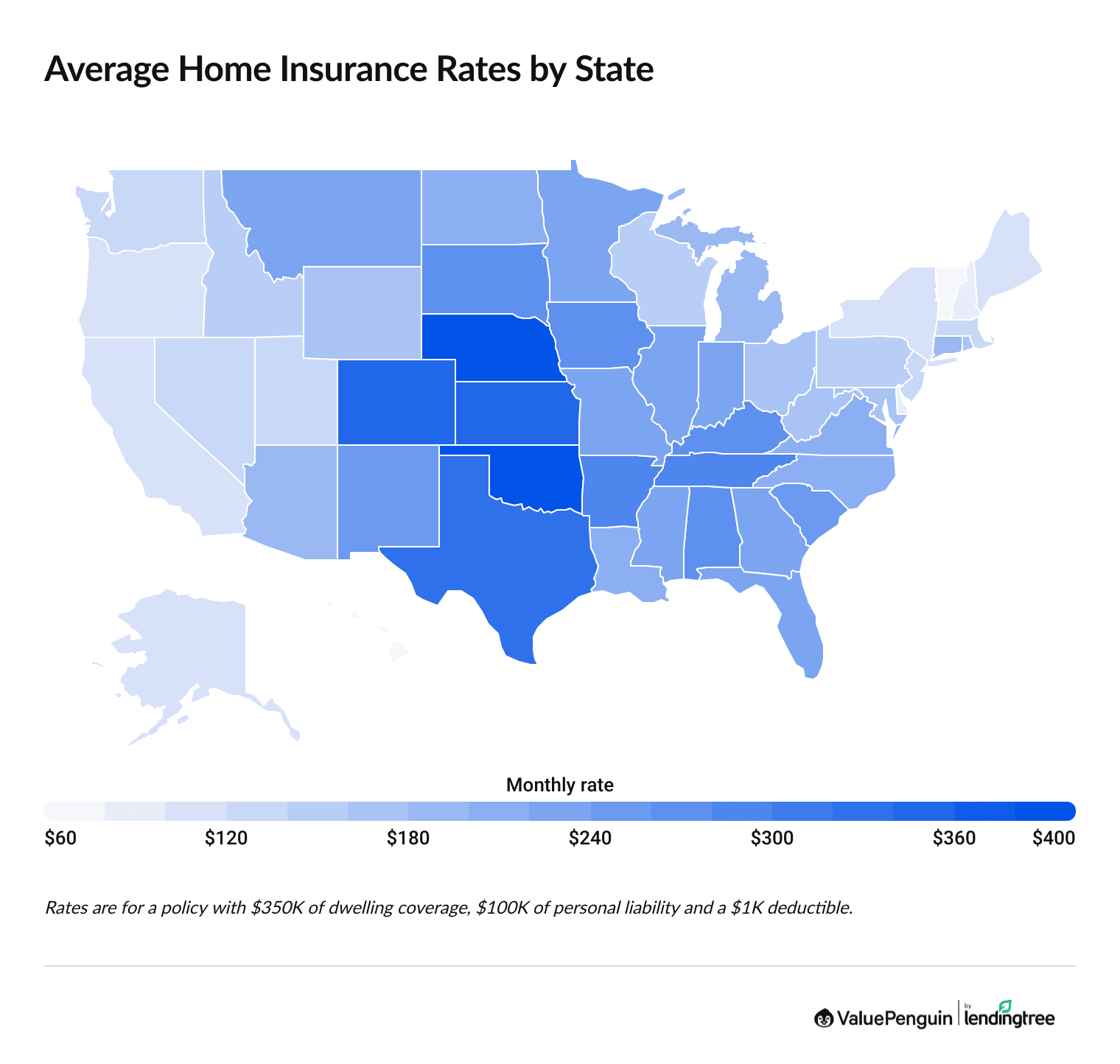
Even within a state, rates can vary widely. Your home insurance could be more expensive if your city or ZIP code has more claims, higher crime rates or severe weather events.
Good customer service is important in helping you get your life back to normal quickly after a disaster.
USAA, Amica, Chubb and Erie have the best-rated customer service, based on J.D. Power customer satisfaction ratings, the National Association of Insurance Commissioners (NAIC) complaint index and ValuePenguin's own editor's ratings.
Company | J.D. Power rank
?
| Complaints
?
| |
|---|---|---|---|
| USAA* | 4/5 | No. 1* | 48% less than avg. |
| Amica | 4.5/5 | No. 1 | 79% less than avg. |
| Chubb | 3.5/5 | No. 2 | 96% less than avg. |
| Erie | 2.7/5 | No. 3 | 46% less than avg. |
| State Farm | 3.4/5 | No. 5 | 35% more than avg. |
| American Family | 2.8/5 | No. 7 | 9% more than avg. |
| Nationwide | 3.4/5 | No. 8 | 20% more than avg. |
| Allstate | 3.3/5 | No. 12 | 18% more than avg. |
| Farmers | 3/5 | No.15 | 28% less than avg. |
| Progressive | 2.3/5 | No. 17 | 79% more than avg. |
| Auto-Owners | 3.7/5 | No. 18 | 48% less than avg. |
| Travelers | 1.7/5 | No. 20 | 31% less than avg. |
*USAA is only available to current and former military members and their families. It does not qualify for official ranking in the J.D. Power study.
Customer service is an important part of what you're paying for with home insurance. A major storm or fire will disrupt your day-to-day life. It could even require you to move out of your home for weeks or months. Great customer service will make the claims process stress-free and get you back in your home more quickly.
Every insurance company has positive and negative qualities. When comparing homeowners insurance companies, it's important to decide which features are the most important to you.
Home insurance quotes can look different from one company to the next. The coverage types and limits you choose affect your quote, so you'll need to make sure that each quote meets your needs.
The examples below are real policies owned by members of ValuePenguin's team. You can see how the coverage limits and prices vary.For example, the home insurance policy from Allstate is $4,726 per year. It's much more expensive than the policies from Liberty Mutual and AAA, but it also includes a lot more coverage.



It's also very important to look at the deductible on your quote.
In the example above, the AAA and Liberty Mutual quotes both have a $1,000 deductible.
However, the Allstate deductible varies depending on the cause of damage to your home. Damage caused by wind or hail has a $5,715 deductible, and tropical cyclone damage comes with an $11,430 deductible.
So if you chose the Allstate policy, you would have to pay a lot more to repair your roof if your shingles blew off in a storm.
In this situation:
Comparing your coverage options helps you build the right policy for your needs.
Home insurance comes with standard coverage options, and you can buy add-ons for extra protection.
Standard coverage includes:
Dwelling
Coverage A: Dwelling
Other structures
Coverage B: Other structures
So if your home is insured for $350,000, you'll have $35,000 of other structures coverage.
Personal property
Coverage C: Personal property
So if your home is insured for $350,000, you'll have between $70,000 and $175,000 of personal property coverage, depending on your policy.
Loss of use
Coverage D: Loss of use
So if your home is insured for $350,000, you'll have between $70,000 and $105,000 of loss of use coverage, depending on your policy.
Personal liability
Coverage E: Personal liability
Medical payments
Coverage F: Medical payments
Many companies also offer coverage upgrades for an extra cost.
Basic home insurance policies are fairly similar. However, there are a few options that you should understand so that you can make an informed decision.
Your home insurance deductible is the amount you'll pay toward repairing or replacing items after a claim. For example, imagine you had a $1,000 deductible and had to replace your roof for $10,000. The insurance company would write you a check for $9,000, and you would pay $1,000.
Your deductible can range anywhere from $500 to $5,000, and is sometimes a percentage of your dwelling coverage limit. The amount you choose directly affects your insurance quotes.
Choosing a low deductible will raise your insurance cost. A higher deductible will result in cheaper rates.
It's important to choose your deductible based on how much you feel comfortable spending in an emergency.
The most common home insurance policy types are HO-3 and HO-5. The main difference between these options is that an HO-5 policy includes more protection for your personal property.
HO-5 policies offer more coverage, so they're typically more expensive.
There are two common types of coverage that insurance companies offer for personal property: actual cash value and replacement cost.
Not all homeowners benefit from the extra protection offered by replacement cost coverage. But the added cost may be worth it if you care about having brand-new items.
These factors can make a big difference when it comes to the cost of your home insurance.
It's important to understand what's included in your quote so you can make an apples-to-apples price comparison.
After you've compared rates, companies and coverage, it's time to buy a policy.
You might be able to do this online, but you might need to work with a local agent. Either way, there are a few steps to follow.
The average cost of home insurance in the U.S. is $2,395 per year, or roughly $200 per month.
Amica offers the best balance of low rates and excellent customer service, and it's available to most homeowners across the country. But the best home insurance for you depends on what you need in a policy.
To find the best homeowners insurance rates, compare quotes from multiple companies. Homeowners should also make sure they're taking advantage of available discounts.
For example, consider bundling home and auto policies. And let your insurance company know if you have a security system, fire safety devices or an impact-resistant roof.
The cheapest home insurance typically comes from smaller regional companies, such as DB Insurance in Hawaii, Norfolk &
QBE offers homeowners, renters and builders insurance for new construction homes. We found QBE to be a poor choice for most homeowners due... Read More
Travelers is the largest business insurance provider in the U.S. for both commercial liability and non-liability insurance. Progressive is... Read More
First American Title is the largest title insurance company in the U.S. It sold $3.3 billion in policy premiums in 2023.... Read More
Depending on the state, the average price increase after a blaze can be as high as... Read More
Fifty-two percent of Americans who have experienced a natural disaster weren’t as prepared as they could have... Read More
Most large-scale renovation projects aren't covered by standard homeowners insurance. It's important to review your policy to ensure you... Read More
To find the best cheap homeowners insurance, ValuePenguin compared quotes from top companies in every residential ZIP code across the country. Rates are for a 45-year-old married man with good credit and no prior insurance claims. Rates are based on the average home age and size in each state.
Quotes include:
ValuePenguin's analysis used insurance rate data from Quadrant Information Services. These rates were publicly sourced from insurer filings and should be used for comparative purposes only — your own quotes may be different.

Senior Writer
Lindsay Bishop is a Senior Writer at ValuePenguin, where she educates readers about home, auto, renters, flood and motorcycle insurance.
Lindsay began her career in the insurance and financial industry in 2010. She was a licensed auto, home, life and health insurance agent and held Series 6 and 63 financial licenses.
After a hiatus from the financial sector, Lindsay returned to the industry as a content writer for ValuePenguin in 2021. She enjoys having the opportunity to help readers make smart decisions about their insurance so they can be prepared for anything life throws their way.
When Lindsay isn't writing about insurance, you can find her spending time with family, enjoying the outdoors on Sunday long runs or riding her Peloton.
How insurance helped Lindsay
As a homeowner for 15 years located in South Carolina, Lindsay has plenty of experience navigating the coastal insurance market and managing the claims process. That includes successfully negotiating a full roof replacement claim.
Expertise
Referenced by
Education
