
Pickleball Injuries Nearly Quadrupled Since 2018, With Older Adults Most Affected

Pickleball has exploded in popularity over the past decade, but as more people pick up a paddle, many are ending up in the emergency room. This ValuePenguin study finds that pickleball-related ER visits have nearly quadrupled since 2018 — and older adults are bearing the brunt of those injuries.
Here’s a closer look at how players get injuries, what types of injuries are most common and how health insurance can help alleviate the financial hit after a pickleball injury.
On this page
- Key findings
- Pickleball-related emergency room visits nearly quadrupled between 2018 and 2025
- Older adults accounted for the majority of pickleball-related ER visits
- Falls were the most common cause of pickleball injuries
- Most pickleball injuries aren’t serious
- Fractures and strains/sprains were the most common diagnoses
- Tips on managing pickleball injury costs
- Methodology
Key findings
- Pickleball-related emergency room visits nearly quadrupled between 2018 and 2025. U.S. pickleball injuries treated in emergency rooms rose from an estimated 8,304 in 2018 to 32,960 in 2024 before falling slightly to 31,463 in 2025.
- Older adults accounted for the majority of pickleball-related ER visits between 2018 and 2025. Adults 50 and older accounted for an estimated 125,287 ER visits in this period, or 83.4% of the total. Those 65 and older represented 55.6% of estimated visits.
- Falls were the most common cause of pickleball injuries. Falls, slips and trips accounted for an estimated 64,753 ER visits between 2018 and 2025, representing 43.1% of pickleball-related injuries. Unspecified injuries accounted for 29.8% of pickleball injuries, while strains, tears and pulls comprised 9.5%.
- Most pickleball injuries aren’t serious. Treated-and-released cases accounted for an estimated 123,417 visits, or 82.1% of the total. Meanwhile, 22,182 visits, or 14.8%, resulted in hospitalization or admission for further care.
- Fractures and strains/sprains were the most common injury diagnoses. Fractures accounted for an estimated 35,935 visits, or 23.9% of the total. Strains and sprains were the reason for 33,258 visits, or 22.1%.
Pickleball-related emergency room visits nearly quadrupled between 2018 and 2025
U.S. pickleball injuries treated in emergency rooms rose from an estimated 8,304 in 2018 to 32,960 in 2024 — nearly quadrupling — before falling slightly to 31,463 in 2025.
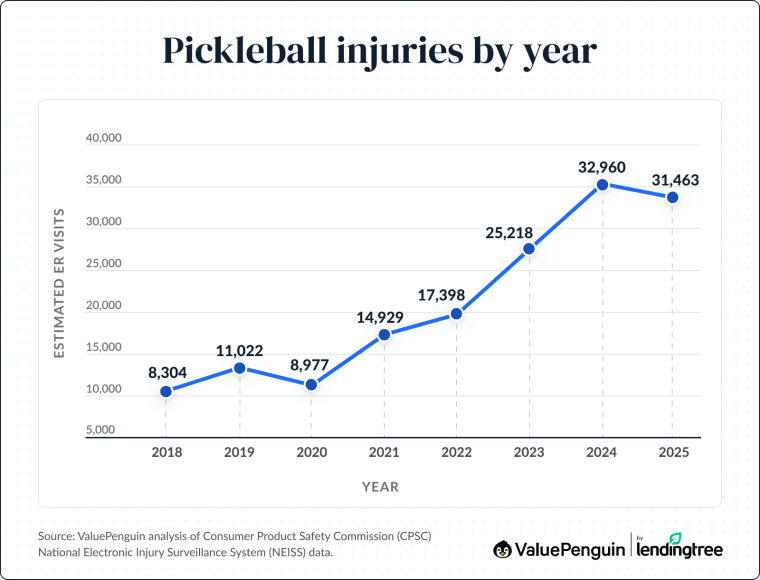
It’s worth noting that this study only captures injuries treated in emergency rooms. Without knowing the total number of people playing or the total hours of pickleball played each year, it’s hard to say if people are getting injured more often playing pickleball or if it’s just that more people are playing pickleball.
Either way, from a health insurance standpoint, ValuePenguin health insurance expert Cate Deventer says a broader rise in sports-related injuries is worth paying attention to.
"Patients who get hurt playing pickleball or other recreational sports may be more likely to be faced with deductibles, copays and coinsurance when they visit the doctor, because going to the doctor more often usually means you have to pay more," she says. "Individual accidents and injuries aren’t likely to affect premiums, but a broader increase in these types of claims could push rates up."
Older adults accounted for the majority of pickleball-related ER visits
Adults 50 and older accounted for an estimated 125,287 ER visits between 2018 and 2025. That’s 83.4% of all pickleball-related emergency visits during this time. Breaking that down further, adults ages 65 to 74 made up the single largest share of injuries at 38.8%, followed by those ages 50 to 64 at 27.8% and adults 75 and older at 16.8%.
By comparison, younger age groups were far less represented. Adults 18 to 34 and 35 to 49 accounted for 6.7% and 6.8% of injuries, respectively. Children and teens younger than 18 made up just 3.1% of overall injuries.

For older adults, Deventer says, health insurance coverage considerations are especially important.
"For seniors on traditional Medicare, coverage is a little more straightforward," she says. "Traditional Medicare generally covers medically necessary services, but you’re still responsible for deductibles and coinsurance unless you have a Medigap plan."
Coverage can get more complicated for those with Medicare Advantage plans, making it "especially important" for older adults to understand how their policies cover injuries, Deventer says. "Medicare Advantage plans work more like traditional health insurance than Medicare, which means the coverage can vary between plans."
Age is not the only factor impacting injuries on the pickleball court, though. Men were slightly more likely to visit the hospital due to a pickleball-related injury than women, at 53.3% versus 46.7%. That breaks down to 80,082 estimated ER visits among men, versus 70,162 among women.
Falls were the most common cause of pickleball injuries
Falls, slips and trips were the leading cause of injuries by a wide margin, accounting for an estimated 64,753 ER visits between 2018 and 2025, or 43.1% of pickleball-related injuries. Unspecified injuries were the second most common at 44,762, or 29.8% of pickleball injuries. Strains, tears and pulls ranked third at 14,232, or 9.5%.

Deventer says most of these injuries would be covered by insurance.
"Most health insurance plans cover injuries from recreational activities the same way they cover other accidents and health issues," she says. "You may also have a copay when you go to the doctor, urgent care or emergency room. You’ll also pay toward your deductible, if you haven’t already met it. If you’ve already met your deductible, you’ll split the bill with your insurance company, which is called coinsurance."
For insurance purposes, it’s also important to be mindful of where you’re seeking treatment (unless, of course, it’s an emergency). "Make sure you know which doctors and hospitals are in your plan’s network," Deventer says. "Unless it’s an emergency, many plans require you to visit in-network doctors to have coverage."
Most pickleball injuries aren’t serious
Treated-and-released cases accounted for an estimated 123,417 visits, or 82.1% of all pickleball-related ER visits from 2018 through 2025. Another 22,182 visits — or 14.8% — resulted in hospitalization or admission for further care.
A smaller share of patients were treated and transferred to another facility (1.5%), left without being seen (0.8%) or were held for observation (0.4%). Fatalities, including patients who were dead on arrival or died in the ER, accounted for an estimated 574 visits, or 0.4% of the total.

Regardless of severity, emergency room visits can be expensive — even with insurance, Deventer says.
"Patients may have to pay a flat fee, called a copay, on top of a deductible or coinsurance," she says. "They may also see various charges from specialists who work in the emergency room, such as a radiologist who takes X-rays. The exact amount they have to pay depends on their specific health plan, whether they’ve met their deductible and what kind of healthcare they needed during the visit."
Fractures and strains/sprains were the most common diagnoses
When it comes to the most common injury diagnoses, other or unspecified injuries top the list at 44,497 visits, or 29.6% of the total. Fractures ranked second, at 35,935 visits (23.9%), followed closely by strains and sprains at 33,258 visits (22.1%).

Meanwhile, more serious diagnoses were far less common. Internal injuries accounted for 12,676 visits (8.4%), and contusions and abrasions rounded out the list at 8,650 visits (5.8%).
Tips on managing pickleball injury costs
Even though pickleball is considered a low-impact sport, injuries can still happen. Understanding your health insurance coverage before you need medical care can help you avoid unexpected costs and make better decisions if you get hurt. We offer the following advice:
- Know how your health plan works before an injury happens. "Before you end up in the ER with a pickleball injury, take time to understand your deductible, copays and coinsurance," Deventer says. "Not knowing how your coverage works can lead to confusion and surprise bills when you need care."
- Review your medical bills carefully. Don’t assume every charge is correct. Check your Explanation of Benefits (EOB) to make sure the services listed match the care you received and that your insurer processed the claim correctly.
- Stay in-network for follow-up care. Many pickleball injuries may require additional doctor visits, physical therapy or imaging tests. Using in-network providers for follow-up treatment can help keep your out-of-pocket costs lower.
- Choose coverage that matches your activity level. "When comparing plans, make sure you understand what you’re signing up for," Deventer says. "Plans with lower deductibles and more favorable cost-sharing typically mean you’ll pay less when you need medical care, though they usually come with higher monthly premiums. If you’re active and can afford the higher monthly cost, a low-deductible plan may save you money overall because your insurance starts covering expenses sooner."
Methodology
ValuePenguin researchers utilized annual Consumer Product Safety Commission (CPSC) National Electronic Injury Surveillance System (NEISS) files released for 2018 through 2025.
Pickleball injury cases were identified using a uniform text screen across all years. A record was included as a pickleball injury if the supplied narrative contained "pickleball" or "pickle ball," or a common misspelling, including "pickelball," "pickel ball," "picklball," "picleball" or "picle ball."
The analysis didn’t rely on a product code alone because pickleball isn’t cleanly captured by a fully specific, stand-alone NEISS product code across the study period. The narrative screen was used to identify pickleball-specific candidate cases consistently across years.
For each candidate case, the NEISS weight variable was used to estimate national emergency room-treated visits. The percentages of total visits were calculated from weighted estimates.
About the Author

Senior Writer, Consumer Research
Maggie Gunara is a senior staff writer at ValuePenguin. She primarily focuses on breaking down complex data and research about the financial lives of Americans into digestible content through our studies and surveys. Her reporting has been featured in numerous publications, such as Forbes and USA Today.
Education
- BA, Journalism, Pepperdine University
Editorial note: The content of this article is based on the author's opinions and recommendations alone. It has not been previewed, commissioned or otherwise endorsed by any of our network partners.
