
Heat-Related Deaths Fall for Second Straight Year but Remain Elevated


Extreme heat is a deadly threat. According to provisional Centers for Disease Control and Prevention (CDC) data, heat was a contributing factor in 1,837 U.S. deaths in 2025. The good news, however, is that figure is going down — 2025 marks the second consecutive year that the number of heat-related deaths declined.
Here’s a closer look at where heat-related deaths are most common and who’s most vulnerable. We’ll also go over how your health insurance can prepare you for the heat as summer approaches.
On this page
Key findings
- Heat was a contributing factor in 1,837 U.S. deaths in 2025, according to provisional data. This marks an increase from 1,719 in 2022, but a decline from 2,415 in 2023 and 2,394 in 2024.
- Heat-related deaths relative to population are most common in Arizona and Nevada. From 2022 to 2025, heat was among the causes of death for 2,940 people in Arizona and 1,029 in Nevada, equating to 9.81 and 7.97 deaths, respectively, per 100,000 residents.
- Among states with qualified heat-related deaths in the same period, rates are lowest relative to the population in New Jersey and Virginia. In total, 13 people died in New Jersey and 18 in Virginia, equivalent to 0.03 and 0.05 deaths, respectively, per 100,000 residents.
- Older Americans face higher heat-related death rates than younger Americans. The most vulnerable group is those 85 and older, with an annual rate of 2.13 deaths per 100,000 residents. That's compared with 0.02 per 100,000 among those ages 5 to 14.
- By race, American Indian and Alaska Native residents have the highest heat-related death rate. The rate among this group is 1.56 deaths per 100,000 residents annually, compared with 0.77 among Black residents and 0.63 among white residents.
Heat-related deaths fall for second straight year
Provisional data shows that heat was a contributing factor in 1,837 U.S. deaths in 2025.

That’s down from a peak of 2,415 in 2023 and 2,394 in 2024, marking the second consecutive year of decline. However, the 2025 figure is still higher than the 1,719 heat-related deaths recorded in 2022.
Heat-related deaths are most common in Arizona and Nevada
Heat-related deaths relative to population are most common in two desert states: Arizona and Nevada.
From 2022 to 2025, 2,940 people in Arizona and 1,029 people in Nevada died due to heat-related causes. That equates to 9.81 and 7.97 deaths, respectively, per 100,000 residents. Louisiana ranks next, with 203 heat-related deaths from 2022 to 2025 — or 1.11 per 100,000 residents.
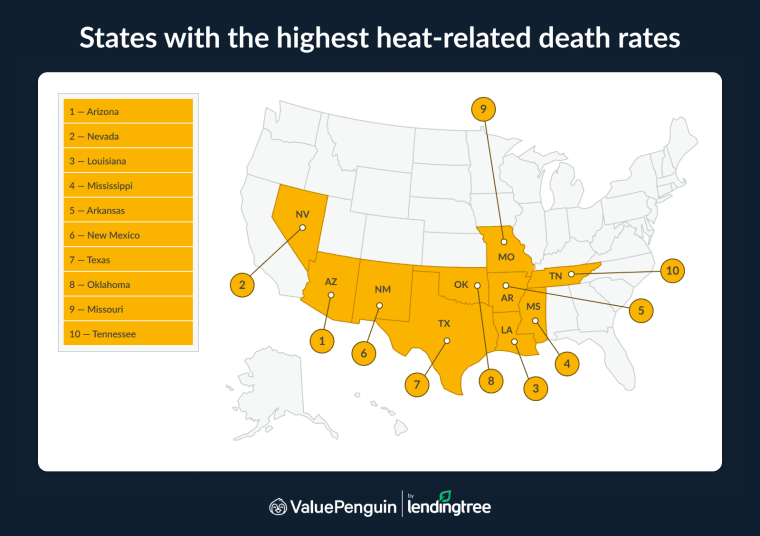
For people living in (or traveling to) extreme-heat states, ValuePenguin health insurance expert Cate Deventer says preparation is key.
"If you live in an area that’s prone to extreme heat, or if extreme heat is forecasted for your area, no matter where you live, you should try to plan ahead," she says. "Know where the in-network urgent care locations are in your area, or check to see if your plan covers telehealth options. Know the signs of heatstroke and how to protect yourself."
By contrast, heat-related death rates are lowest in New Jersey and Virginia, where 13 and 18 people died, respectively, from 2022 to 2025, equating to just 0.03 and 0.05 deaths per 100,000 residents. Utah follows, also at 13 deaths, or 0.09 per 100,000 residents.
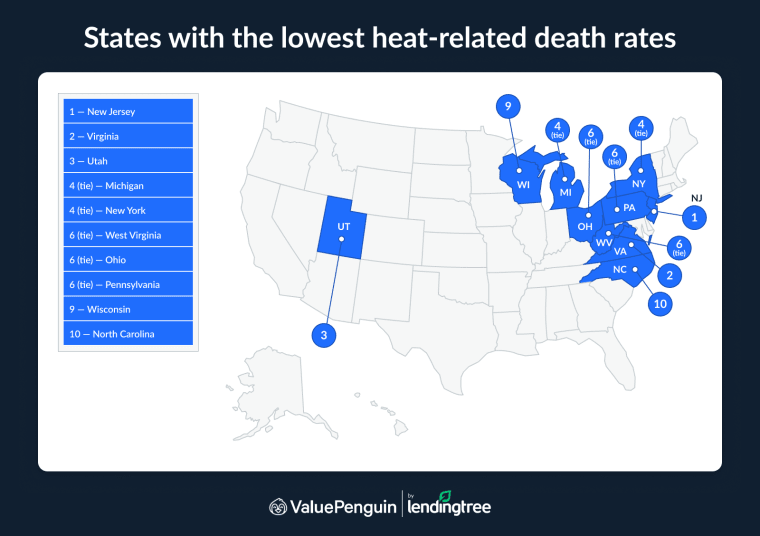
Full rankings: States with the highest rates of heat-related deaths
Rank | State | Deaths | Annualized rate per 100,000 residents |
|---|---|---|---|
| 1 | Arizona | 2,940 | 9.81 |
| 2 | Nevada | 1,029 | 7.97 |
| 3 | Louisiana | 203 | 1.11 |
| 4 | Mississippi | 112 | 0.95 |
| 5 | Arkansas | 116 | 0.94 |
| 6 | New Mexico | 75 | 0.88 |
| 7 | Texas | 1,027 | 0.83 |
| 8 | Oklahoma | 121 | 0.74 |
| 9 | Missouri | 126 | 0.51 |
| 10 | Tennessee | 128 | 0.45 |
| 11 | South Carolina | 95 | 0.44 |
| 12 | Kentucky | 72 | 0.40 |
| 13 | Kansas | 46 | 0.39 |
| 14 | Maryland | 95 | 0.38 |
| 15 | Alabama | 74 | 0.36 |
| 16 | California | 548 | 0.35 |
| 17 | Oregon | 49 | 0.29 |
| 18 | Florida | 258 | 0.28 |
| 19 | Washington | 83 | 0.26 |
| 20 | Colorado | 60 | 0.25 |
| 20 | Iowa | 32 | 0.25 |
| 22 | Georgia | 107 | 0.24 |
| 23 | Indiana | 63 | 0.23 |
| 24 | Illinois | 112 | 0.22 |
| 25 | North Carolina | 87 | 0.20 |
| 26 | Wisconsin | 46 | 0.19 |
| 27 | Pennsylvania | 83 | 0.16 |
| 27 | Ohio | 74 | 0.16 |
| 27 | West Virginia | 11 | 0.16 |
| 30 | New York | 89 | 0.11 |
| 30 | Michigan | 43 | 0.11 |
| 32 | Utah | 13 | 0.09 |
| 33 | Virginia | 18 | 0.05 |
| 34 | New Jersey | 13 | 0.03 |
Source: ValuePenguin analysis of Centers for Disease Control and Prevention (CDC) Provisional Mortality Statistics data. Notes: This analysis includes deaths where heat-related reasons were listed as one of the causes of death from 2022 to 2025. 2025 data is provisional. States with zero deaths aren’t included in the rankings.
Older Americans, American Indian and Alaska Native residents at greatest risk
Age and race are two of the strongest predictors of heat-related death risk in the U.S.
By age, those 85 and older face the most risk, dying from heat-related causes at a rate of 2.13 deaths per 100,000 residents annually — more than 100 times the rate seen among the group with the lowest heat-related deaths, those ages 5 to 14. This group experiences 0.02 deaths per 100,000 residents.

For seniors, insurance coverage can play a role in access to heat-related care, according to Deventer.
"Traditional Medicare usually focuses on treatment rather than prevention," she says. "However, Medicare Advantage plans often have extra benefits that can help seniors prevent health issues from happening. Each plan is different, though, so it’s important to check your plan’s documents to know what your perks are."
Racial disparities are similarly stark: American Indian and Alaska Native residents have the highest heat-related death rate, at 1.56 deaths per 100,000 residents annually.
White residents, meanwhile, have a much lower rate of heat-related deaths, at 0.63 per 100,000 residents. The rate for Black residents is 0.77.
Rate of heat-related deaths (by race)
Race | Deaths | Annualized rate per 100,000 residents |
|---|---|---|
| American Indian or Alaska Native | 286 | 1.56 |
| Asian | 177 | 0.20 |
| Black or African American | 1,422 | 0.77 |
| White | 6,329 | 0.63 |
| More than one race | 133 | 0.32 |
Source: ValuePenguin analysis of CDC Provisional Mortality Statistics data. Notes: This analysis includes deaths where heat-related reasons were listed as one of the causes of death from 2022 to 2025. 2025 data is provisional.
Health insurance tips to stay protected during extreme summer heat
As temperatures continue trending upward, early forecasts suggest summer 2026 could bring prolonged heat waves across much of the U.S., especially in already high-risk regions. Taking steps to stay protected can make a meaningful difference as extreme heat becomes a more consistent and dangerous part of summer, in 2026 and beyond:
- Know your in-network options before a heat emergency. "Check your health insurance coverage before extreme heat hits so you’re not scrambling during a medical situation," Deventer says. "Identify nearby urgent care centers and primary care providers that are in-network, since out-of-network visits can be significantly more expensive. Reviewing your plan details ahead of time can help you avoid surprise bills when timing is critical."
- Act quickly — and know when insurance protections apply. Understanding the symptoms of heatstroke — such as confusion, high body temperature and lack of sweating — can save lives. Most insurance plans cover emergency care regardless of network status in life-threatening situations, but acting quickly is key to both health outcomes and minimizing complications.
- Use preventive care and telehealth to catch heat-related issues early. Not every heat-related illness starts as an emergency. Symptoms like dehydration, dizziness or fatigue, for instance, can often be treated before they escalate. Many health plans cover preventive visits and telehealth appointments at no cost, giving you a way to check in with a doctor quickly if your situation isn’t an emergency. Exploring options can help you take advantage of these benefits and avoid more serious (and costly) complications.
Methodology
ValuePenguin researchers analyzed Centers for Disease Control and Prevention (CDC) Provisional Mortality Statistics data to find the states where heat-related reasons were listed as one of the causes of death. We then estimated deaths per 100,000 residents.
Specifically, researchers examined the following scenarios listed as causes of death:
- Heatstroke and sunstroke
- Heat syncope
- Heat cramp
- Heat exhaustion, anhidrotic
- Heat exhaustion due to salt depletion
- Heat exhaustion, unspecified
- Heat fatigue, transient
- Heat edema
- Other effects of heat and light
- Effect of heat and light, unspecified
- Exposure to excessive natural heat (hyperthermia)
The Provisional Mortality Statistics data is based on death certificates for U.S. residents. While we looked at data from 2022 through 2025, the 2025 data is provisional. That means the 2025 data — an early estimate — hasn’t been fully reviewed by the National Center for Health Statistics.
Also, statistics by state for a given year are suppressed when there are zero to nine deaths in a given year to maintain confidentiality. We used "zero" to represent those years when data was suppressed.
About the Author

Senior Writer, Consumer Research
Maggie Gunara is a senior staff writer at ValuePenguin. She primarily focuses on breaking down complex data and research about the financial lives of Americans into digestible content through our studies and surveys. Her reporting has been featured in numerous publications, such as Forbes and USA Today.
Education
- BA, Journalism, Pepperdine University
Editorial note: The content of this article is based on the author's opinions and recommendations alone. It has not been previewed, commissioned or otherwise endorsed by any of our network partners.
