
Nearly 1 in 6 Gun Owners in States Studied Store a Firearm Unlocked and Loaded at Home

Firearm ownership is a common part of life, but storage practices vary widely — often raising significant safety concerns.
ValuePenguin research shows that while roughly one-third (31.6%) of adults across states with available data report having a firearm in or around their home, a notable share of gun owners store at least one unsafely by keeping it unlocked and loaded.
These patterns differ significantly by geography, income level and other factors. However, findings are based on a limited group of states and aren’t nationally representative. Here’s a closer look.
On this page
- Key findings
- 15.5% of gun owners store a firearm unlocked and loaded
- Adults with children in Wyoming are most likely to store a firearm unlocked and loaded
- Gun owners in the South are most likely to store a firearm unlocked and loaded
- Lower-income gun owners are more likely to store firearms unsafely
- 6.1% of adults without children report unsafe firearm storage
- Properly storing firearms: Home and health tips
- Methodology
Key findings
- About 1 in 3 (31.6%) adults in the 17 states analyzed report having a firearm in or around their home. Among gun owners, 15.5% store at least one unlocked and loaded.
- In some states, about 1 in 10 adults with children report an unlocked, loaded firearm in the home. Wyoming (10.6%) and Mississippi (10.3%) have the highest shares among adults with children. New Jersey (0.2%) and California (0.7%) rank lowest among the states with available data.
- Among gun owners, unsafe storage is most common in Southern states. Louisiana leads, with 27.4% of gun owners reporting an unlocked, loaded firearm in the home, followed by Mississippi (24.8%). Among the states with available data, New Jersey (5.3%) and Minnesota (8.4%) are the only two below 10.0%.
- Firearm ownership generally increases with income, but unsafe storage is more common among lower-income gun owners. Just 16.5% of adults earning less than $25,000 report a firearm at home, compared with 39.0% of those earning $50,000 to $99,999 and 38.9% of those earning $100,000 or more. However, among gun owners, 21.2% of those earning less than $25,000 report an unlocked, loaded gun, versus 14.1% of those earning $100,000 or more.
- Adults without children are more likely to report unsafe firearm storage. Overall, 6.1% of adults without children report an unlocked, loaded gun at home, compared with 2.4% of those with children. Among gun owners, the shares are 19.2% versus 7.7%.
Those 17 states are:
- California
- Illinois
- Indiana
- Louisiana
- Maine
- Michigan
- Minnesota
- Mississippi
- Nevada
- New Jersey
- New Mexico
- North Carolina
- Oregon
- South Carolina
- Virginia
- West Virginia
- Wyoming
15.5% of gun owners store a firearm unlocked and loaded
Across the 17 states with available data, 31.6% of adults report having a firearm in or around their home.
Firearm ownership varies sharply by state. Among those 17 states, Wyoming has the highest share, with 65.8% of adults reporting a gun in or around the home, followed by West Virginia (59.9%) and Mississippi (59.4%). Conversely, New Jersey (13.7%), California (17.6%) and Illinois (22.2%) have the lowest rates.
Among adults in those same states, 4.9% say they store at least one gun unlocked and loaded in the home. That rises to 15.5% among gun owners, but it’s a practice that CDC researchers say may increase the risk of injury, death or unauthorized access, particularly for children and other household members.

Full rankings: States where adults have a firearm in or around their home
Rank | State | % with a firearm in or around their home |
|---|---|---|
| 1 | Wyoming | 65.8% |
| 2 | West Virginia | 59.9% |
| 3 | Mississippi | 59.4% |
| 4 | Louisiana | 51.1% |
| 5 | South Carolina | 47.3% |
| 6 | Maine | 44.0% |
| 7 | Indiana | 42.9% |
| 8 | North Carolina | 41.2% |
| 9 | Michigan | 41.1% |
| 10 | Virginia | 40.5% |
| 11 | Minnesota | 37.9% |
| 12 | New Mexico | 37.6% |
| 13 | Nevada | 37.3% |
| 14 | Oregon | 36.4% |
| 15 | Illinois | 22.2% |
| 16 | California | 17.6% |
| 17 | New Jersey | 13.7% |
Source: LendingTree analysis of Centers for Disease Control and Prevention (CDC) 2024 Behavioral Risk Factor Surveillance System (BRFSS) data. Notes: The analysis only includes states with available firearm data. Estimates are based on survey responses and are weighted to represent adults.
Adults with children in Wyoming are most likely to store a firearm unlocked and loaded
Where children are present, firearm storage practices can carry especially high stakes — and the data shows wide variation by state. Among the states with available data, Wyoming has the highest share of adults with children storing a firearm unlocked and loaded in the home, at 10.6%, followed by Mississippi (10.3%) and Louisiana (8.9%).
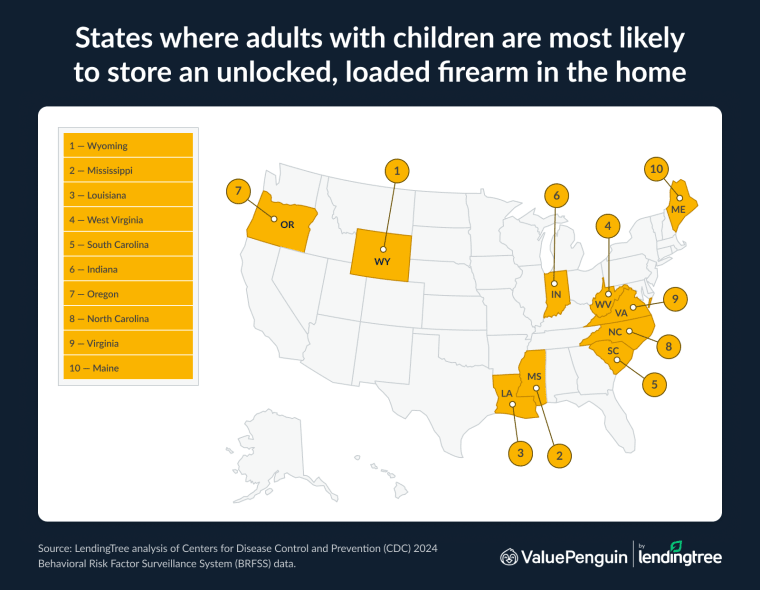
Meanwhile, New Jersey (0.2%) and California (0.7%) are the only states with available data that are under 1.0%. New Mexico (1.3%) is closest.
Full rankings: States where adults with children store an unlocked, loaded firearm in the home
Rank | State | % of adults with children reporting an unlocked, loaded firearm in the home |
|---|---|---|
| 1 | Wyoming | 10.6% |
| 2 | Mississippi | 10.3% |
| 3 | Louisiana | 8.9% |
| 4 | West Virginia | 8.1% |
| 5 | South Carolina | 5.8% |
| 6 | Indiana | 3.6% |
| 7 | Oregon | 2.7% |
| 8 | North Carolina | 2.4% |
| 9 | Virginia | 2.3% |
| 10 | Maine | 1.9% |
| 11 | Michigan | 1.6% |
| 11 | Minnesota | 1.6% |
| 13 | Illinois | 1.4% |
| 14 | New Mexico | 1.3% |
| 15 | California | 0.7% |
| 16 | New Jersey | 0.2% |
Source: LendingTree analysis of CDC 2024 BRFSS data. Notes: The analysis only includes states with available firearm data. Estimates are based on survey responses and weighted to represent adults. Results based on small sample sizes are suppressed, so Nevada isn’t included here.
Gun owners in the South are most likely to store a firearm unlocked and loaded
Specific to gun owners, unsafe storage is most common in Southern states. Across the states with available data, Louisiana leads, with 27.4% of gun owners reporting at least one unlocked, loaded firearm in the home. Mississippi (24.8%) and Wyoming (23.1%) follow.
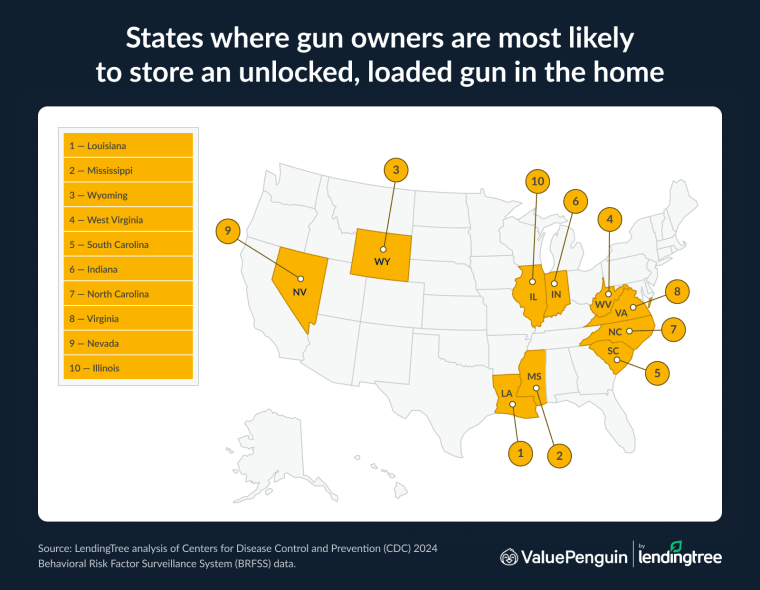
Conversely, New Jersey ranks last among states with available data at 5.3%. Minnesota (8.4%) and California (10.0%) follow. (Nevada is again included in this analysis because its sample size among gun owners is large enough to meet reporting thresholds.)
Several factors may help explain why Southern states tend to rank higher. Unsafe storage is closely tied to lower incomes (more on that later), which are more prevalent in the two highest-ranking Southern states. Additionally, policy differences may also play a role. States with stricter gun storage laws — like New Jersey and California — tend to report lower rates of unsafe storage, while states with fewer regulations often report higher rates.
Full rankings: States where gun owners are most likely to store an unlocked, loaded gun at home
Rank | State | % of gun owners with an unlocked, loaded gun in the home |
|---|---|---|
| 1 | Louisiana | 27.4% |
| 2 | Mississippi | 24.8% |
| 3 | Wyoming | 23.1% |
| 4 | West Virginia | 22.8% |
| 5 | South Carolina | 20.4% |
| 6 | Indiana | 18.6% |
| 7 | North Carolina | 18.3% |
| 8 | Virginia | 15.4% |
| 9 | Nevada | 14.0% |
| 10 | Illinois | 13.9% |
| 11 | Oregon | 13.5% |
| 12 | New Mexico | 13.1% |
| 13 | Michigan | 11.7% |
| 14 | Maine | 10.7% |
| 15 | California | 10.0% |
| 16 | Minnesota | 8.4% |
| 17 | New Jersey | 5.3% |
Source: LendingTree analysis of CDC 2024 BRFSS data. Notes: The analysis only includes states with available firearm data. Estimates are based on survey responses and are weighted to represent adults.
Lower-income gun owners are more likely to store firearms unsafely
Firearm ownership tends to rise with income, but safer storage doesn’t follow the same pattern.
While 16.5% of adults earning less than $25,000 in the analyzed states report having a firearm in or around their home, that share jumps to 39.0% among those earning $50,000 to $99,999 and 38.9% among those earning $100,000 or more.

At the same time, lower-income gun owners are more likely to report unsafe storage. Among those earning less than $25,000, 21.2% say they keep at least one firearm unlocked and loaded in the home, compared with 14.1% of those earning $100,000 or more.
This gap can partially be attributed to differences in access to safe storage resources, such as gun safes or lockboxes, which can be cost-prohibitive for some households. In contrast, higher-income households are more likely to have the means and space to invest in secure storage solutions, potentially reducing the likelihood of unsafe practices.
6.1% of adults without children report unsafe firearm storage
Adults without children in the analyzed states are more likely to report unsafe firearm storage than those with children in the home. Overall, 6.1% of adults without children say they keep an unlocked, loaded firearm in the home, compared with 2.4% of adults with children.
The gap is even wider among gun owners: 19.2% of those without children report unsafe storage, versus 7.7% of those with children.
Properly storing firearms: Home and health tips
Safe firearm storage plays a critical role in protecting both your household and your finances. Taking a few proactive steps can significantly reduce these risks while also helping you avoid costly medical bills or liability issues. We offer the following advice:
- Use secure storage devices consistently. Store firearms in a locked safe, in a lockbox or with a trigger lock, and keep ammunition stored separately whenever possible. These tools can significantly reduce the risk of unauthorized access and accidents.
- Consider the health and financial risks of unsafe storage. Unsecured firearms are associated with higher rates of accidental shootings and suicide, which can have devastating emotional and financial consequences. Medical costs from firearm-related injuries can be significant, making prevention especially important.
- Review liability and specialty insurance coverage. In some cases, homeowners may be held liable if an improperly stored firearm is used in an accident or injury. Reviewing your home insurance or renters insurance policy can help protect you from potential financial losses.
Methodology
LendingTree analyzed 2024 data from the Centers for Disease Control and Prevention (CDC) Behavioral Risk Factor Surveillance System (BRFSS), a large, nationally representative survey of U.S. adults. The dataset includes responses from hundreds of thousands of individuals and is weighted using the CDC’s person-level weights to reflect population-level estimates.
While the BRFSS is nationally representative, this analysis was restricted to respondents in the 17 states that included the firearm module and had valid responses to key questions, so results reflect only those states and aren’t representative of the entire U.S.
Those 17 states are:
- California
- Illinois
- Indiana
- Louisiana
- Maine
- Michigan
- Minnesota
- Mississippi
- Nevada
- New Jersey
- New Mexico
- North Carolina
- Oregon
- South Carolina
- Virginia
- West Virginia
- Wyoming
Adults were classified as having a firearm if they answered "yes" to "Are any firearms now kept in or around the house?" Firearm storage was classified as unlocked and loaded if respondents answered "yes" to "Are any of these loaded firearms also unlocked?"
Several metrics were calculated using different denominators to provide context. Firearm ownership rates are based on all adults with valid responses. Measures of unsafe storage are shown both as a share of all adults and as a share of gun owners. Additional cuts focus on adults with children in the household, using only respondents who reported having children.
Demographic breakdowns were created using BRFSS categorical variables. Income groups were grouped into four brackets:
- Less than $25,000
- $25,000 to $49,999
- $50,000 to $99,999
- $100,000 or more
Respondents with missing, refused or invalid responses for key variables were excluded from relevant calculations.
Because the BRFSS surveys one adult per household, all estimates represent adults rather than households or individual firearms. Results are based on self-reported data and may be subject to reporting bias. To ensure reliability, estimates based on fewer than 50 unweighted respondents were suppressed and are not shown in state-level tables.
About the Author

Senior Writer, Consumer Research
Maggie Gunara is a senior staff writer at ValuePenguin. She primarily focuses on breaking down complex data and research about the financial lives of Americans into digestible content through our studies and surveys. Her reporting has been featured in numerous publications, such as Forbes and USA Today.
Education
- BA, Journalism, Pepperdine University
Editorial Note: The content of this article is based on the author's opinions and recommendations alone. It has not been previewed, commissioned or otherwise endorsed by any of our network partners.
